
Thin Section Petrography
Thin Section Petrography for Reservoir Characterisation
Detailed petrographical assessment of thin sections, core plugs and cuttings to identify rock composition, texture, pore systems, diagenetic history and the controls on reservoir quality.
Integrated thin-section preparation, petrographical description, point counting, SEM and XRD analysis,
helping clients understand why reservoir quality varies and how that variation can be predicted within a sedimentological framework.
Turning rock samples into reservoir insight
Our Expertise
Thin-section petrography is a core part of reservoir geoscience. By examining the mineralogy, grain fabric, pore types, cements, clay content and diagenetic features of a rock sample, we can identify the geological controls that influence porosity, permeability and flow behaviour.
Expert Guidance
Our thin-section studies can be delivered as standalone petrographical assessments or integrated with core sedimentology, conventional core analysis, XRD, SEM, MICP, borehole image data, wireline logs and reservoir architecture studies.
Typical applications include:
-
Identifying controls on reservoir quality
-
Characterising pore types, cements and clay distribution
-
Distinguishing depositional and diagenetic controls on porosity and permeability
-
Supporting rock typing and reservoir quality prediction
-
Calibrating petrographical observations with core, log and special core analysis data
-
Providing visual, auditable descriptions through thin-section plates and photomicrographs

Thin-section services
Core Technical Solutions
01
Thin-section preparation
Preparation of standard covered thin sections, with optional staining depending on study objectives.
Available preparation options include:
-
Standard thin section with coverslip
-
Thin section with carbonate staining
-
Thin section with carbonate and K-feldspar staining
-
Cleaning and preparation of core plug or cuttings material prior to analysis
03
Modal and textural analysis
Quantitative petrographical analysis can be used to provide repeatable data for reservoir quality assessment and rock typing.
Typical outputs include:
-
Point counting for modal mineralogy
-
Quantitative textural analysis
-
Cement and pore-type characterisation
-
Visual macroporosity estimates
-
Quality control by senior petrographers
02
Petrographical description
Detailed petrographical descriptions can include:
-
Lithology and framework grain composition
-
Grain size, sorting, roundness and textural maturity
-
Detrital clay and matrix abundance
-
Cement types, distribution and timing
-
Pore types and visible porosity
-
Compaction and diagenetic overprint
-
Reservoir quality observations
-
Photomicrograph plates and description data packages
04
SEM and XRD integration
Where required, thin-section observations can be integrated with SEM and XRD analysis to improve understanding of fine-scale mineralogy, clay distribution, pore-lining and pore-filling phases, and diagenetic controls on reservoir quality.
A phased workflow tailored to the question
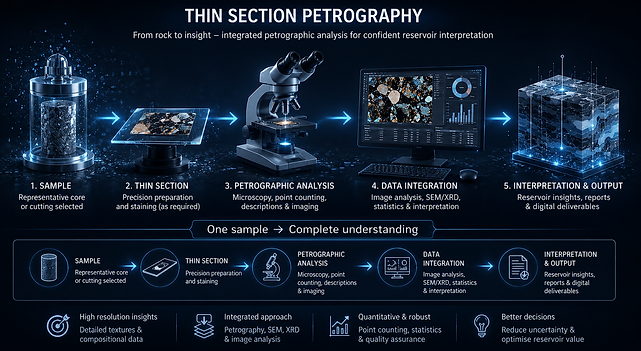
A typical thin-section petrography project can include:
-
Representative sample selection
Selection of samples for data collection and advanced petrographical evaluation.
-
Thin-section preparation
Preparation of covered or stained thin sections, with cleaning and sample handling as required.
-
Petrographical description
Detailed thin-section descriptions focused on texture, composition, pore systems, cements and reservoir quality.
-
Point counting and quantitative analysis
Quantitative characterisation of cement types, pore types, grain composition and visual macroporosity.
-
Thin-section scanning and photomicrography
Creation of high-quality visual records and annotated plates.
-
SEM and XRD, where required
Additional analytical support for mineral identification, clay characterisation and pore-scale assessment.
-
Data integration and technical assurance
Integration with available core, log, CCA, MICP or sedimentological data, with senior technical review.
-
Results presentation
Delivery of a clear final presentation or report, with practical conclusions for reservoir characterisation, modelling or field development decisions.
What thin-section petrography helps answer
Thin-section petrography provides direct evidence for the geological controls that influence reservoir performance.
It can help answer questions such as:
-
Is reservoir quality controlled mainly by depositional texture, detrital clay, cementation or compaction?
-
Which pore types contribute most to effective storage and flow?
-
How does reservoir quality vary between facies, rock types or stratigraphic intervals?
-
Can petrographical observations explain scatter in porosity and permeability data?
-
Which features should be captured in static models or reservoir quality prediction workflows?
-
Where might heterogeneity, baffles or barriers affect production behaviour?
Examples of application
Reservoir quality prediction
In a Zubair Formation study in Kuwait, thin-section petrography, XRD, SEM and MICP data were integrated with sedimentological observations to evaluate the controls on reservoir quality. The study showed that reservoir quality was strongly influenced by primary depositional detrital clay content, with additional control from grain size and minor quartz cementation in cleaner deposits. Petrographical rock types provided a stronger link to reservoir quality trends than descriptive lithotype schemes alone.
Routine petrography from cuttings
In a North Sea Rotliegend example, cuttings, conventional logs, routine petrography and XRD were used to refine facies interpretation in an uncored exploration well. Petrographical observations helped test the depositional model by assessing grain size distributions, lithology, clay abundance and grain fabrics.
Integrated reservoir architecture
In clastic reservoir architecture studies, petrographical data can be combined with core, logs, borehole image data, facies maps, production data and conventional core analysis. This allows reservoir quality controls to be upscaled within a depositional and architectural framework.
Typical deliverables
Depending on the scope, deliverables may include:
-
Prepared thin sections, with optional staining
-
Thin-section description spreadsheet or database
-
Thin-section plates and photomicrographs
-
Quantitative point-counting results
-
Modal mineralogy and textural analysis outputs
-
Cement and pore-type characterisation
-
SEM and XRD summary outputs, where included
-
Integrated reservoir quality interpretation
-
Technical presentation of key findings
-
Recommendations for further analysis or modelling integration
Need thin-section petrography support?
Whether you require a small set of stained thin sections, a full petrographical description package, or an integrated reservoir quality study, we can tailor the workflow to your samples, data availability and technical objectives.
From thin sections to better decisions

CTS combines detailed petrographical expertise with sedimentology, reservoir quality analysis and reservoir architecture experience. This means thin-section observations are not treated in isolation; they are used to explain reservoir behaviour and support practical subsurface decisions.
Our work is supported by senior technical review and can be scaled from rapid screening studies to fully integrated reservoir quality and rock-typing projects.
👉 Not just measurement — interpretation
Need thin-section petrography support?
Whether you require a small set of stained thin sections, a full petrographical description package, or an integrated reservoir quality study, we can tailor the workflow to your samples, data availability and technical objectives.
WHY CTS
CTS combines detailed petrographical expertise with sedimentology, reservoir quality analysis and reservoir architecture experience. This means thin-section observations are not treated in isolation; they are used to explain reservoir behaviour and support practical subsurface decisions.
Our work is supported by senior technical review and can be scaled from rapid screening studies to fully integrated reservoir quality and rock-typing projects.