

Understand pore systems, capillary pressure, and rock quality with confidence
High Pressure Mercury Injection delivers detailed pore throat size distribution and drainage capillary pressure data for rock typing, saturation modelling, SCAL preparation, and reservoir evaluation.
-
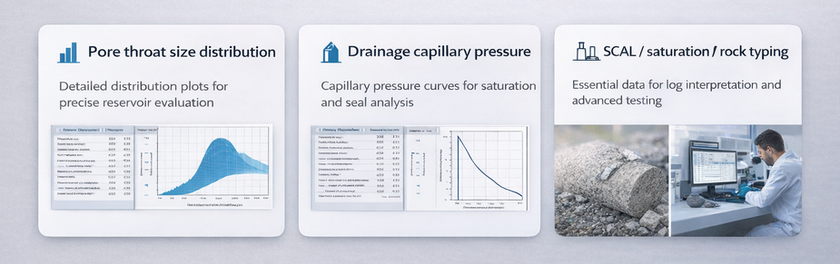
Detailed pore throat size distribution for carbonates and clastics
-
Drainage capillary pressure data for saturation height modelling
-
Trusted support for SCAL, formation damage, and cap rock evaluation
Request a sample HPMI report
Speak to a specialist
Why HPMI matters
High Pressure Mercury Injection is one of the most useful and cost-effective tools for evaluating porous core materials. It provides detailed characterisation of pore systems and supports decisions across petrophysics, geology, petrography, reservoir engineering, and drilling and completions.
For many projects, the real value lies in answering questions such as:
-
How is pore access distributed through the rock?
-
What does the capillary behaviour tell us about saturation and seal quality?
-
Which samples are best suited for SCAL and further advanced testing?
What HPMI delivers
Pore throat size distribution
A core output from HPMI is detailed pore throat size distribution, helping you characterise the pore system and compare reservoir quality across intervals and rock types.
Drainage capillary pressure
HPMI also provides drainage capillary pressure curves, which are especially valuable where rocks show bi-modal, multi-modal, or otherwise complex pore throat size distributions. Your source material notes this as a direct input to core- and log-based saturation height modelling.
Broader pore system characterisation
-
The AutoPore documentation states that mercury porosimetry can be used to calculate pore size distribution, total pore volume, total pore surface area, median pore diameter, and bulk and skeletal density.
Why HPMI instead of lower-resolution alternatives
Complex rocks need higher-resolution capillary insight
Where pore systems are bi-modal or multi-modal, HPMI provides the detail needed to characterise complex behaviour and support more reliable saturation and rock quality interpretation.
APPLICATIONS
HPMI supports a wide range of subsurface workflows.
Saturation and petrophysics
-
Interpretation of log- and core-derived water saturation data
-
Selection of pressure points for capillary pressure
-
Input to saturation height modelling
Reservoir characterisation
-
Rock typing in carbonates and clastics
-
Reservoir baffle and cap rock evaluation
-
Detailed pore system comparison between samples and facies
SCAL and laboratory workflows
-
Sample selection for SCAL
-
Restoration of water saturation prior to SCAL
-
Interpretation of SCAL data
Drilling and production
-
Bridging package design for drilling fluid optimisation
-
Formation damage analysis
Technology
We operate Micromeritics AutoPore IV systems for fast, accurate porosimetry analysis. Your brochure states the platform can measure pore diameters from 0.003 to 360 μm, offers high-resolution intrusion/extrusion measurement, and supports both scanning and equilibrated modes up to 60,000 psia
Platform highlights
-
Pore diameter range: 0.003 to 360 μm
-
33,000 psi and 60,000 psi model options
-
High-resolution intrusion and extrusion measurements better than 0.1 μL
-
Enhanced data reduction options including tortuosity, permeability, compressibility, pore-throat ratio, fractal dimension, and more
Why Core Technical Services
HPMI supports a wide range of subsurface workflows.
Experience
More than 15 years of experience and many thousands of HPMI datasets analysed.
Capacity
Two Micromeritics AutoPore IV units.
Interpretation and integration
Our in-house consultants can support interpretation and integration where required.
Commercial value
HPMI offers a highly cost-effective solution for pore system characterisation — we welcome comparisons with your current provider.
Advanced Quality Control & Permeability Validation

Beyond standard HPMI deliverables, we offer advanced quality control and permeability validation workflows. These workflows provide an additional layer of confidence in both measured data and derived reservoir properties.
-
Independent permeability estimation from HPMI data using multiple methodologies
-
Cross-validation against core measurements to identify anomalies and artefacts
-
Pore system characterisation using statistical and distribution-based approaches
-
Enhanced interpretation for tight reservoirs and complex pore structures
Using established approaches such as cumulative pore throat contribution and capillary pressure-based modelling, permeability can be derived directly from HPMI data and compared against laboratory measurements. This provides a powerful QC framework, particularly in cases where microfractures or sample effects may distort routine core analysis results
Turn HPMI data into reservoir insight
Request a sample report or speak to our team about pore system characterisation, capillary pressure, and SCAL support.