
CCUS Support
De-risk Carbon Storage with Integrated Digital Core Analysis
Accelerating seal integrity, injectivity and long-term storage confidence through integrated digital core analysis.
-
Seal integrity & capillary entry pressure
-
CO₂–rock interaction & mineral reactivity
-
Injection pressure & geomechanical limits
-
Dynamic CO₂ flow & hydrate risk testing
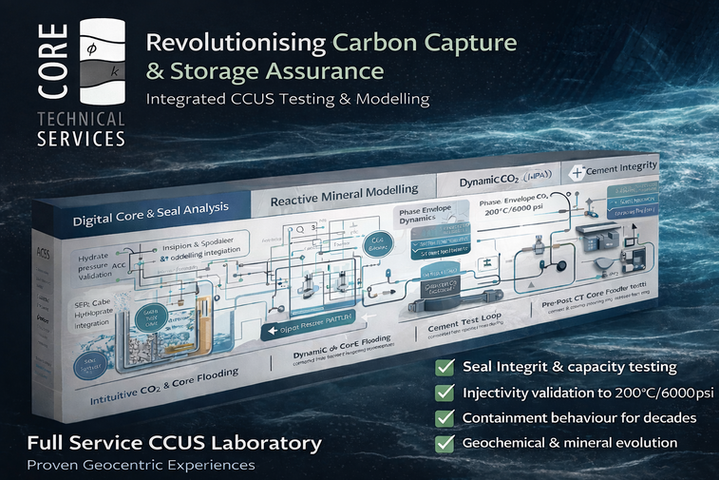
The CCUS Challenge
-
Successful carbon storage depends on multiple interacting risks:
-
Seal integrity under long-term CO₂ exposure
-
Accurate capillary entry pressure
-
Mineral reactions and porosity evolution
-
Injection pressure constraints
-
Geomechanical stability
-
Scaling from core to reservoir
-
Traditional workflows are slow, fragmented, and often reactive — leading to late-stage surprises and increased project risk
Our Approach
Early, Integrated, Predictive
We deliver a fully integrated digital core workflow that combines:
-
Imaging
-
Rock physics
-
Mineralogy & geochemistry
-
Capillary analysis
-
Dynamic CO₂ testing
-
Reservoir-scale modelling
All aligned at centimetre-scale resolution and delivered early in the project lifecycle
Integrated CCUS Workflow
Our workflow bridges laboratory measurements and reservoir modelling:
-
Digital core imaging & logging
-
Continuous mineralogy & geochemical modelling
-
Capillary seal analysis
-
Rock mechanics & injection constraints
-
Dynamic CO₂ core flooding
-
Hydrate and scaling validation
-
Reservoir-scale upscaling
Core Capabilities
Seal Integrity & Capillary Entry Pressure
-
HPMI / MICP analysis
-
Pore throat distribution
-
Capillary entry pressure
-
Column height prediction
Mineralogy & Geochemical Modelling
-
XRF + XRD + SEM integration
-
Continuous mineral logs
-
Reactive transport modelling
-
CO₂–rock interaction prediction
High-Resolution CT Imaging
-
Whole-core imaging
-
Fracture detection
-
Density & fabric mapping
CoreDNA
-
Continuous, non-destructive measurements
-
Strength, velocity, permeability indices
-
Ultra-high-resolution imagery
Digital Rock Physics & Upscaling
-
Digital porosity & permeability
-
Digital SCAL
-
Reservoir-scale modelling
Dynamic CO₂ Testing
Injection & Phase Behaviour
-
Injection P–T modelling
-
Hydrate window validation
-
Phase envelope compatibility
Dynamic CO₂ Core Flooding
-
CO₂ + brine injection
-
Reservoir conditions (pressure & temperature)
-
Residual saturation testing
Hydrate Risk Testing
-
In-situ hydrate formation
-
Joule–Thomson cooling simulation
-
Inhibitor evaluation
Scaling & Formation Damage
-
Halite precipitation
-
Carbonate scaling
-
Fines mobilisation
Cement & Well Integrity
-
CO₂–cement interaction
-
Corrosion & degradation testing
-
CT + SEM validation
Rock Mechanics & Injection Constraints
We define safe operating envelopes through:
-
Continuous UCS profiling
-
Elastic property testing
-
Thermal fracturing assessment
-
Maximum injection pressure estimation
Applications Across CCUS Lifecycle
Appraisal & Site Selection
-
Seal screening
-
Mineral reactivity
-
Hydrate risk
Pre-FID
-
Injectivity testing
-
P–T modelling integration
-
Well integrity
Operations
-
Injectivity diagnostics
-
Scaling mitigation
-
Model updates
Why CTS for CCUS
-
Integrated digital + dynamic workflow
-
Reservoir-condition testing
-
Hydrate & scaling risk quantification
-
Cement & well integrity expertise
-
Cross-disciplinary integration
The Outcome
Confidence. Control. Faster Decisions.
-
Increased storage confidence
-
Reduced containment uncertainty
-
Controlled injectivity risk
-
Improved regulatory readiness
-
Early identification of critical risks
De-Risk Your Storage Asset Early
👉 Talk to our CCUS team